
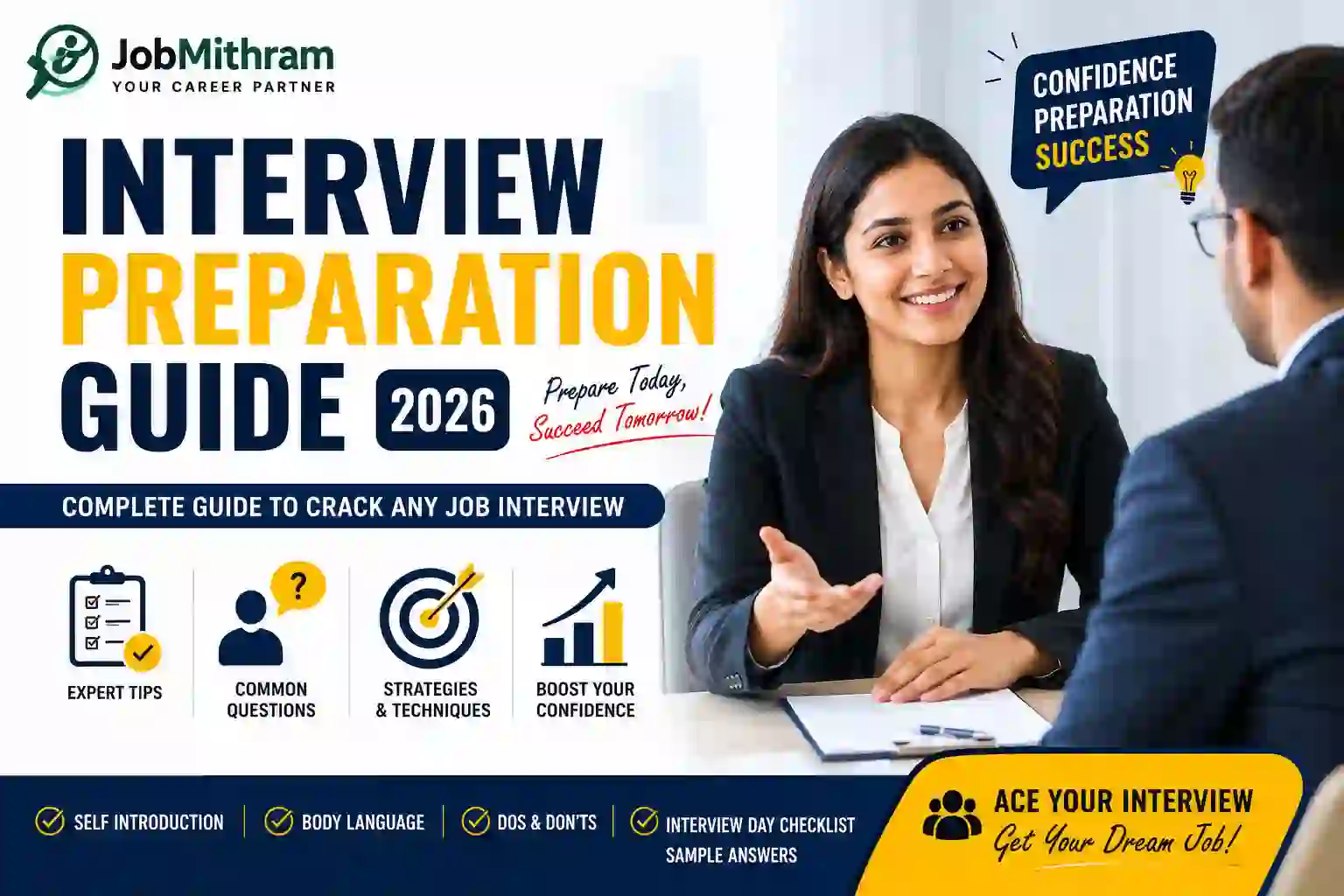
Interview Preparation Guide: Everything You Need to Know Before Facing an Interview
Getting shortlisted for an interview is exciting, but many candidates lose opportunities because they don’t prepare properly. Whether you’re attending a government job interview, bank interview, co-operative sector interview, private company selection, or campus placement, preparation is the key to success.
This Interview Preparation Guide will help you understand exactly what interviewers expect, how to answer confidently, and how to leave a lasting impression.
Table of Contents
Why Is Interview Preparation Important?
An interview is not just a question-answer session. It is an opportunity for employers to evaluate:
- Your communication skills
- Subject knowledge
- Confidence level
- Problem-solving ability
- Professional attitude
- Cultural fit
- Leadership qualities
- Decision-making skills
Even highly qualified candidates can fail if they attend interviews without preparation.
Understanding Different Types of Interviews
1. Face-to-Face Interviews
Traditional interview conducted in person.
Usually includes:
- HR round
- Technical round
- Final managerial round
2. Online Interviews
Conducted through:
- Google Meet
- Zoom
- Microsoft Teams
Popular among remote recruiters.
3. Panel Interviews
Multiple interviewers assess the candidate simultaneously.
Tips:
- Maintain eye contact with everyone.
- Address the person who asked the question.
4. Technical Interviews
Focuses on:
- Subject knowledge
- Practical applications
- Industry concepts
Common in banking, engineering, accounting, and IT sectors.
5. Behavioral Interviews
Interviewers assess past behavior to predict future performance.
Example:
“Tell us about a time you handled a difficult situation.”
How to Prepare Before the Interview
Research the Organization
Understand:
- Company’s history
- Services offered
- Vision and mission
- Recent achievements
- Industry position
For government and co-operative jobs, understand:
- Structure of the department
- Recent initiatives
- Relevant Acts and Rules
Study the Job Description
Know:
- Roles and responsibilities
- Required skills
- Qualification requirements
- Expected competencies
Align your answers accordingly.
Review Your Resume Thoroughly
Many candidates fail because they forget what they wrote.
Be prepared to explain:
- Educational background
- Projects
- Achievements
- Work experience
- Career gaps
How to Introduce Yourself
This is usually the first question.
Sample Self-Introduction
“Good morning, sir/madam. My name is ________. I completed my graduation in ________ from ________. I have developed strong interest in ________. I am hardworking, eager to learn, and passionate about contributing effectively to the organisation. Thank you for this opportunity.”
Tips
- Keep it under 60–90 seconds.
- Be confident.
- Avoid memorised speeches.
Most Common Interview Questions
Tell Me About Yourself
Focus on:
- Education
- Experience
- Skills
- Career goals
Why Should We Hire You?
Mention:
- Relevant skills
- Adaptability
- Willingness to learn
- Commitment
What Are Your Strengths?
Examples:
- Communication skills
- Time management
- Teamwork
- Leadership
- Problem-solving
What Are Your Weaknesses?
Choose manageable weaknesses.
Example:
“I sometimes focus too much on details, but I’m learning to balance perfection with efficiency.”
Avoid saying:
- “I don’t have weaknesses.”
Why Do You Want This Job?
Explain:
- Career growth
- Interest in the sector
- Opportunity to contribute
Avoid:
“Because I need money.”
Where Do You See Yourself in Five Years?
Discuss:
- Professional growth
- Learning opportunities
- Leadership aspirations
Why Did You Leave Your Previous Job?
Stay positive.
Avoid criticizing employers.
Behavioral Questions Using STAR Method
STAR stands for:
S – Situation
Explain the context.
T – Task
Describe your responsibility.
A – Action
Explain what you did.
R – Result
Share the outcome.
Example
Question: Describe a challenge you faced.
Situation:
A project deadline was advanced unexpectedly.
Task:
Coordinate the team.
Action:
Redistributed responsibilities.
Result:
Completed successfully before deadline.
Government and Bank Interview Preparation Tips
If attending interviews for:
- PSC
- Banking
- Co-operative sector
- Insurance sector
Prepare these areas.
Current Affairs
Study:
- National news
- Kerala developments
- Economic updates
- Banking reforms
Subject Knowledge
For commerce candidates:
- Accounting principles
- Banking operations
- Auditing basics
- Financial awareness
Department Knowledge
Understand:
- Functions
- Services
- Regulatory framework
Communication Skills Improvement
Practice:
- Speaking clearly
- Avoiding filler words
- Active listening
- Proper pronunciation
Record yourself and analyse your responses.
Body Language Tips
Positive body language creates strong impressions.
Maintain Eye Contact
Shows confidence.
Sit Properly
Avoid slouching.
Smile Naturally
Appears approachable.
Use Controlled Hand Movements
Avoid excessive gestures.
Offer Firm Handshake (if applicable)
Not too weak or aggressive.
Dress Code for Interviews
Men
- Formal shirt
- Formal trousers
- Polished shoes
- Groomed appearance
Women
- Formal salwar
- Saree
- Formal western attire
- Minimal accessories
Avoid
- Strong perfumes
- Casual wear
- Excessive makeup
- Loud accessories
Online Interview Preparation
Technical Setup
Check:
- Internet connection
- Camera
- Microphone
- Headphones
Environment
Choose:
- Quiet room
- Proper lighting
- Clean background
Login Early
Join 10–15 minutes before schedule.
Common Mistakes to Avoid
Many candidates lose jobs because of these mistakes.
Avoid:
- Arriving late
- Lack of preparation
- Interrupting interviewers
- Negative comments about previous employers
- Giving false information
- Dressing inappropriately
- Using mobile phones during interviews
- Poor body language
Questions You Can Ask Interviewers
At the end, interviewers may ask:
“Do you have any questions?”
Ask:
- What does success look like in this role?
- What are the next steps?
- What training opportunities are available?
Avoid asking salary questions immediately unless initiated.
Interview Day Checklist
Before leaving:
✓ Resume copies
✓ Certificates
✓ ID proof
✓ Passport-size photographs
✓ Pen
✓ Water bottle
✓ Directions to venue
✓ Interview call letter
Managing Interview Anxiety
Feeling nervous is normal.
Practice Mock Interviews
Confidence improves through repetition.
Deep Breathing
Helps reduce stress.
Positive Visualization
Imagine successful performance.
Sleep Well
Aim for 7–8 hours before interview day.
After the Interview
Thank the Interviewers
Maintain professionalism.
Reflect on Performance
Identify strengths and areas for improvement.
Follow Up Professionally
If appropriate, send a polite thank-you email.
Who Should Read This Interview Preparation Guide?
This guide is useful for:
- Government job aspirants
- Bank exam candidates
- Co-operative recruitment applicants
- Fresh graduates
- Experienced professionals
- Campus placement candidates
- Private sector job seekers
Frequently Asked Questions
1. How many days should I prepare for an interview?
Ideally 5–7 days of focused preparation.
2. What should I wear to an interview?
Formal and professional attire.
3. Is it okay to admit I don’t know an answer?
Yes. Be honest and explain how you would learn it.
4. How long should self-introduction be?
About 60–90 seconds.
5. How can I improve confidence?
Practice mock interviews regularly.
6. Are current affairs important?
Yes, especially for government and banking interviews.
7. Can body language affect selection?
Absolutely. First impressions matter.
8. Should I ask questions at the end?
Yes, thoughtful questions demonstrate interest.
9. What documents should I carry?
Resume, certificates, ID proof, photographs, and call letter.
10. Is interview preparation necessary for freshers?
Yes. Preparation significantly improves success rates.
Final Thoughts
An interview is not designed to scare candidates. It is simply an opportunity to demonstrate your knowledge, attitude, and potential. The more prepared you are, the more confident you become.
Remember: interviews don’t always select the most intelligent person—they often select the candidate who communicates clearly, stays calm under pressure, and demonstrates genuine enthusiasm.
Prepare well, believe in yourself, and walk into your next interview knowing that success is within your reach.
Good luck with your upcoming interview!

