
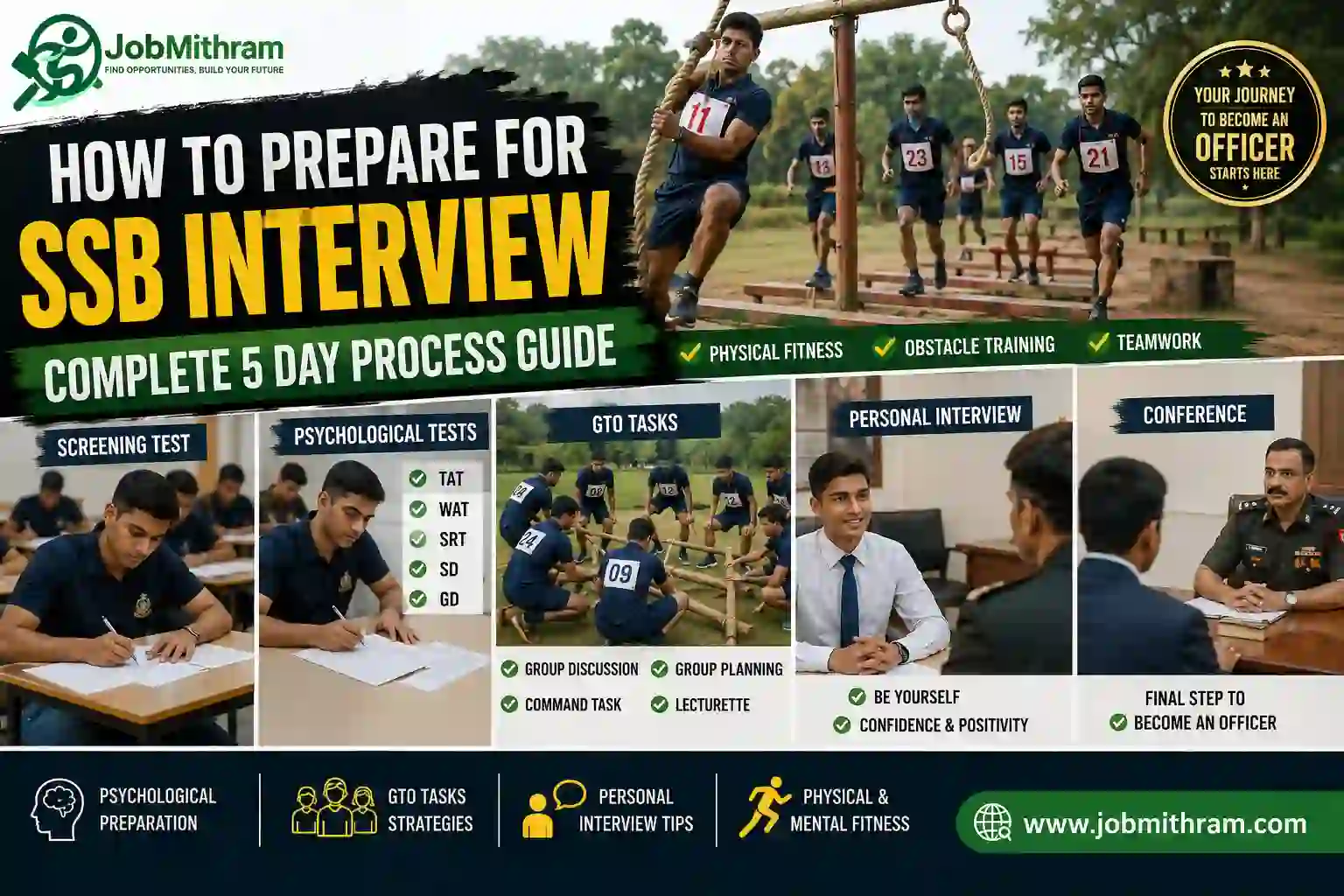
How to Prepare for SSB Interview – Complete 5 Day Process Guide (2026)
How to Prepare for SSB Interview is one of the most common questions asked by NDA, CDS, AFCAT, and other defence aspirants. The Services Selection Board (SSB) interview is a comprehensive 5-day assessment designed to evaluate your Officer Like Qualities (OLQs), personality, leadership, communication skills, decision-making ability, and overall suitability to become an officer in the Indian Army, Indian Navy, or Indian Air Force.
In this complete guide, you’ll learn the entire 5-day SSB interview process, including the Screening Test (OIR & PPDT), Psychological Tests (TAT, WAT, SRT & SD), GTO Tasks, Personal Interview, Conference, preparation strategies, common mistakes, and expert tips to improve your chances of recommendation.
Table of Contents
How to Prepare for SSB Interview: Complete 5-Day Process
Candidates should plan each day with a balanced mix of study, practice, exercise and rest. Below is a sample timetable (times and activities are illustrative) covering all key areas:
| Time | Day 1 (Screening) | Day 2 (Psych Tests) | Day 3 (GTO Part 1) | Day 4 (GTO Part 2) | Day 5 (Interview Prep) |
|---|---|---|---|---|---|
| 05:00–06:30 | Morning run/workout | Morning run & PT | Morning run & agility drills | Morning run & strength training | Morning yoga/stretching |
| 06:30–07:00 | Breakfast | Breakfast | Breakfast | Breakfast | Breakfast |
| 07:00–09:00 | PPDT practice: Write/describing stories from sample pictures; GK/current affairs reading | TAT practice: Story-writing for ambiguous images | Group Discussion (GD) practice: Discuss current topics in a group | Lecturette practice: Prepare & rehearse 3-min talks on random topics | Mock Interview: Practice common PI questions (see Q&A below) |
| 09:00–10:30 | OIR practice: Timed verbal/non-verbal reasoning questions | WAT practice: 60-word sessions, writing first-thought sentences | Group Planning Exercise prep: Role-play planning officer or scribe | Practice obstacles: Simulate command task and lecturette delivery | Current Affairs & Service Knowledge: Review recent events, service news |
| 10:30–11:00 | Break | Break | Break | Break | Break |
| 11:00–13:00 | Theory/Revision: Review SSB procedures, officer-like qualities, read about defense history and your branch knowledge | SRT practice: Write concise responses to situational questions | Progressive Group Task (PGT) prep: Plan teamwork for physical tasks | Command Task prep: Strategy and teamwork drills (e.g. organizing squad to cross obstacles) | Document check & grooming: Arrange certificates, pack clothes and kit (see checklist below) |
| 13:00–14:00 | Lunch/Rest | Lunch/Rest | Lunch/Rest | Lunch/Rest | Lunch/Rest |
| 14:00–16:00 | GD practice: Group debate on issues, focus on clear arguments | SDT practice: Write about your strengths, weaknesses, opinions | Physical Drills: Practice PGT and GOR teamwork (e.g. carrying “snake” rope) | Physical Drills: Obstacle course practice, command simulations | Relaxation & Mental Prep: Light reading or meditation; early dinner |
| 16:00–16:30 | Tea/Break | Tea/Break | Tea/Break | Tea/Break | Prepare clothes/pack bag |
| 16:30–18:30 | Evening Exercise: Strength training (push-ups, sit-ups, pull-ups) | Evening Exercise: Swimming or sports for stamina | Evening Exercise: Team sports (building camaraderie) | Evening Exercise: Long run (build endurance) | Early Night: Get 7–8 hours sleep |
| 18:30–20:00 | Dinner/Rest | Dinner/Rest | Dinner/Rest | Dinner/Rest | — |
| 20:00–21:00 | Review & Planning: Revise learnings (take notes on weak areas) | Review & Planning: Revise stories/sentences written; read newspaper | Review & Planning: Reflect on GD and lecturette performance | Review & Planning: Plan final interview answers; relax (no screens) | — |
| 21:00+ | Early Bedtime: Adequate sleep | Early Bedtime: Adequate sleep | Early Bedtime: Adequate sleep | Early Bedtime: Adequate sleep | Early Bedtime: Adequate sleep |
Day 1: Screening Tests (OIR & PP&DT)
Focus Topics: Officer Intelligence Rating (OIR) and Picture Perception & Discussion Test (PP&DT). Practice speed-based reasoning (verbal and non-verbal puzzles) to improve accuracy under time pressure. For PPDT, hone quick story-writing: a clear “Hero–Problem–Resolution” structure works well. (For example, a sample PPDT prompt – a blurry scene of a fire – could inspire a story: “Riya, a calm college student, spots a burning building. She urges bystanders to move back, calls the fire department, and guides an elderly man to safety. Her presence of mind prevents chaos.”.) During practice, focus on highlighting OLQs like leadership, courage and empathy in your narratives.
Daily routine: Start with physical training (morning run or calisthenics), then 2–4 hours on test practice (alternate PPDT story practice with mock OIR tests), followed by a midday break. In the afternoon, do a mock Group Discussion on a current affairs topic to build confidence in speaking and listening (e.g. national defense news). Conclude with another exercise session (e.g. swimming or team sports) and a light evening study (reading newspapers or defense journals). Ensure at least 7–8 hours of sleep.
Day 2: Psychological Tests (TAT, WAT, SRT, SD)
Focus Topics: Thematic Apperception Test, Word Association Test, Situation Reaction Test, and Self-Description. Practice each under timed conditions. For TAT, write 4–5 sentences per picture, clearly naming a hero, their challenge, and how they resolve it. For WAT, write one concise action-sentence per word, using present tense, active voice and positive framing (e.g. instead of “Fear is weakness”, write “Training helps overcome fear.”). For SRT, skim each scenario quickly and jot a realistic, helpful response in 2–3 lines. Be candid and positive: avoid rash promises or negative language. For SDT, outline your strengths, weaknesses, and how others (parents/teachers/friends) perceive you, being honest and consistent with your earlier answers.
Daily routine: Morning start with cardio. Devote the morning to TAT and WAT practice (e.g. 30-minute drills writing 60 stories and 60 sentences as in exam). After breakfast, do SRT practice (60 situational answers in 30 min). After lunch, write and refine your personal description (SDT). Evening: light exercise (jog or cycling) and revision of key points. Read 30 minutes of defense news before bed.
Day 3: GTO Tasks (Part 1) & Lecturette
Focus Topics: Group Discussion (GD), Group Planning Exercise (GPE), Progressive Group Tasks (PGT), and Group Obstacle Race (GOR). Review objective and procedure of each: GD (discuss topics, influence group), GPE (plan solutions to a given problem as a team), PGT (physical teamwork challenges), and GOR (cross a “snake” obstacle with rope).
Tips: In GD, listen actively and speak logically – structure your points with facts and respect others’ views. In GPE, volunteer for roles (e.g. Planner or Assistant) to outline steps clearly. In PGT/GOR, cooperate and communicate – encourage teammates and help weaker members to show cooperation and leadership. After breaks, practice a 3-minute Lecturette: pick random topics (history, science, current affairs) and speak confidently, using clear opening and conclusion.
Daily routine: Morning run followed by 2 hours of GD/Lecturette drills. Mid-morning, simulate GPE with friends: assign one as “commander” and others as team, solve a mock scenario (e.g. constructing a bridge with limited planks). After lunch, try PGT/GOR practice (using a garden hose or rope to mimic obstacles). Late afternoon: sprint drills or circuit training. Evening: light stretching, review mistakes (be honest about any shortcomings).
Day 4: GTO Tasks (Part 2) & Obstacles
Focus Topics: Remaining GTO tasks: Individual Obstacles (ten sequential challenges), Command Task, and Final Group Task (FGT). Review the rules: for Individual Obstacles, focus on agility and composure; for Command Task, strategize selection of team and objective achievement. The Final Group Task often tests leadership – steps in even informally to guide the team toward a solution.
Tips: Maintain high energy and enthusiasm (liveliness). Volunteer for leadership roles when possible, but stay positive and helpful. In Lecturette (if any topics left), speak with controlled pace and eye contact. Emphasize initiative and stamina in physical activities.
Daily routine: Early gym or run. Spend morning planning for Command Task (e.g. team building strategies) and practising any lecturette topics. After breakfast, try a timed obstacle circuit (find 5–10 backyard obstacles – jumping, balancing). After lunch, simulate a mock Command Task: choose a leader and execute a simple team exercise (like moving objects as a team). Late afternoon: team sports or endurance run. Evening: relax with breathing exercises or meditation, ensuring confidence and calmness for interview day.
Day 5: Personal Interview (PI) & Conference
Focus Topics: Personal interview and final preparations. Practice common PI questions (motivations, background, current affairs) and refine your answers. Prepare anecdotes that showcase OLQs – for example, a time you showed responsibility or teamwork. Be ready to discuss your Comprehensive Information (CIQ) facts (name meaning, family background, hobbies, etc.) clearly. Brush up on current affairs (national/international news, defense updates) and service knowledge (structure of Army/Navy/Air Force, recent operations).
Tips: In the interview, be honest, confident, and concise. Use the STAR method for situational questions. Enduring resilience is valued – if asked about past failures or rejections, frame them as learning experiences.
Daily routine: Light physical activity only (yoga/stretch). Spend morning on mock interviews: have a friend ask sample PI questions (see table below). At mid-day, review important facts (branch details, rank hierarchy, any ongoing defense news). Lay out your clothes (formal shirt/trousers for men; formal suit/salwar for women) and prepare a grooming checklist (see below). Early evening: pack documents and get a full night’s sleep.
Officer-Like Qualities (OLQs) & Marking Scheme
The SSB assesses 15 Officer-Like Qualities, defined by the Defence Institute of Psychological Research, grouped into clusters like Planning & Organizing, Social Effectiveness, Dynamism and Moral Compass. Key examples include leadership, effective intelligence (practical problem-solving), power of expression (communication), social adaptability, cooperation, responsibility, initiative, confidence, and stamina. Every test (psychologist, GTO, interviewer) is designed to reveal these traits through your actions and speech.
The scoring is out of 900 marks (300 each from the Psychologist, Group Testing Officer, and Interviewing Officer). A candidate typically needs at least 90 marks from each assessor to be “recommended”. In the conference, assessors review consistency across all tasks. Demonstrate OLQs continuously: e.g. in GTO tasks show teamwork by including others, in GD show reasoning and expression, and in PI show sense of responsibility and honesty.
Psychological Tests: Strategies & Examples
- TAT (Thematic Apperception Test): Write a 4–5 sentence story for each image (11 pictures + 1 blank slide). Structure each story with a Hero, Problem, and Resolution. Highlight leadership and initiative: e.g. “My hero offered to organize help.” Your blank slide story can showcase your greatest strength (initiative or planning). Example prompt: a person on a bike looking worried. A good story might have the person notice an accident ahead and break to help injured victims, demonstrating courage and prompt action.
- WAT (Word Association Test): For each of 60 words (15 sec each), write a single action-oriented sentence. Use simple, positive language and avoid opinions/definitions. For instance, given “failure” write “Failure motivates preparation for success.”; for “teamwork” write “Teamwork achieves goals through unity and discipline.”. Write in active voice, present tense. Don’t skip many words (max 3–4) to avoid appearing evasive.
- SRT (Situation Reaction Test): Answer 60 brief scenarios in 30 minutes. Focus on practical, positive actions. Example scenarios include: “An airplane crashes near you; as battalion commander, what do you do?” or “Someone snatches a gold chain on the street; you are unarmed. Your response?”. For each, spend no more than 30 seconds: state the first helpful action (e.g. alert authorities, help the victim) and why. Keep answers 2–3 lines. Do not write clichés; be sincere and positive (e.g. “I would immediately rush to assist and secure the area.”).
- SDT (Self-Description Test): Write short paragraphs about yourself: your strengths, weaknesses, values, how others see you. Be honest and consistent with earlier tests. Use this as an opportunity to emphasize qualities like discipline and teamwork.
- PP&DT Example: For a PPDT prompt (e.g. the smoke-and-building image), candidates generate an individual story and then a group story. A model individual story might be: “Riya, a 19-year-old college student, spots smoke and calmly guides people to safety while calling for help. Her composure and quick thinking manage the situation effectively.”. In the group discussion, aim to smoothly integrate elements from others’ stories. Practice these skills by writing a couple of sample stories and timing them.
Group Discussion & GTO Tasks Tips
- Group Discussion (GD): Speak after listening, contribute facts, and try to summarize the group’s consensus. Avoid interrupting; instead, wait for a natural pause. Support your points with evidence (don’t just state opinions) and encourage quieter members to talk to demonstrate cooperation.
- Group Planning Exercise (GPE): If allowed, volunteer or support the Planning Officer, showing planning ability. If you are not leader, contribute original ideas. For example, if given a forest fire scenario, propose a step-by-step firefighting plan.
- Progressive Group Tasks (PGT) / Group Obstacle Race (GOR): These involve physical hurdles. Communicate clearly, help others (e.g. lifting heavier loads together) and take initiative (e.g. “I’ll hold one end of the plank steady”). Demonstrate team spirit and sense of responsibility.
- Lecturette: Prepare one topic in advance for practice. During delivery, outline your talk (introduction, 2–3 main points, conclusion). Speak slowly and confidently, maintain eye contact, and conclude neatly at 3 minutes.
- Command Task: Show leadership by organizing the team, explaining the plan, and verifying each step. Stay calm under pressure, and boost your team’s morale.
Across GTO tasks, always maintain positive body language and energy (liveliness). The GTO is watching not just task completion but how you lead, adapt, and assist the group.
Physical Fitness & Drills
Defence selection demands good stamina and strength. Aim to meet or exceed basic fitness norms (e.g. running 1.6–2 km in ~7–8 minutes, 20–30 push-ups, 30+ sit-ups, moderate chin-ups). Include daily running/jogging (2–5 km) as suggested by training guides. Key drills:
- Cardio: Interval sprints, long runs, swimming or cycling.
- Strength: Push-ups, pull-ups, squats, lunges, sit-ups. Perform sets (e.g. 3×12 push-ups, 3×15 squats).
- Endurance: Circuit training (jumping jacks, burpees, planks).
- Flexibility: Stretching or yoga for muscle recovery.
Regular exercise also boosts confidence and stress-resilience. Keep increasing intensity gradually. A basic checklist: 2–3 km run, 15–20 push-ups, 20–30 sit-ups, and a few chin-ups every morning.
Grooming & Documentation
Appearance: First impressions count. Dress neatly and conservatively on all days. For PD/GTO days wear plain white shorts/T-shirt and white sports shoes (with white socks) as required by SSB venues. On interview day wear formal attire (men: shirt/trousers and optional tie; women: suit or salwar kameez). Keep hair short/combed and nails trimmed; men should be clean-shaven (unless religion prohibits). Avoid loud colors, accessories or visible tattoos.
Documents: Carry originals and photocopies of all certificates. Essentials include: SSB call letter (printed); academic certificates (10th, 12th, degree/NCC/other entry certificates); mark-sheets; proof of age (birth certificate), domicile certificate (if required); caste certificate (if applicable); NCC ‘C’ certificate for NCC entry; and Bonafide/NOC if needed. Also bring 10–20 passport-sized photos (white background) and a basic stationery kit. A signed risk certificate from guardian is mandatory for minors. Keep all documents in a transparent folder.
Below is a pre-interview checklist (table format) summarizing key items:
| Item | Notes |
|---|---|
| SSB Call Letter | Print 2 copies; verify center and date. |
| Educational Certs | Originals & 2 photocopies of 10th, 12th, degree. |
| Mark Sheets | All semester/year mark sheets. |
| ID Proof | Aadhaar/PAN/Voter ID matching DOB. |
| Photos | 10–20 passport-size (white bg). |
| White PT Kit | White shorts, T-shirts, socks, shoes (spare pair). |
| Formal Clothes | Shirt/trousers or salwar suit (ironed). |
| Risk Certificate | (if under 18) signed by parent. |
| NOC | From employer if currently in a Govt/PSU job. |
| Final Prep | Haircut/shave; trim nails; pack bag (water, sleep mask etc.). |
| Anchor Text | URL |
|---|---|
| Join Indian Army Official Website | https://joinindianarmy.nic.in |
| Indian Navy Official Website | https://www.joinindiannavy.gov.in |
| Indian Air Force Official Website | https://afcat.cdac.in |
| UPSC NDA Examination | https://upsc.gov.in |
| Ministry of Defence | https://mod.gov.in |
Personal Interview: Sample Q&A and Rubric
Sample Questions & Model Answers: Below are some common PI questions and concise answer strategies (drawn from coaching advice). Use them as a guide – personalize with your facts.
| Question | Model Answer / Key Points |
|---|---|
| Tell me about yourself. | State name, background, education, family. Mention one strong skill or achievement (e.g. sports captain) that shows discipline or leadership. End with why you chose defense. |
| Why do you want to join the Armed Forces? | Cite motivations: e.g. patriotism, family background, or desire to serve with discipline. Connect to your traits: “I enjoy teamwork and challenge; the army’s discipline and service to nation align with my values.”. |
| Why not corporate/another career? | Explain genuine interest in military life (adventure, service) vs. corporate. Maybe mention role models in armed forces or family inspiration. |
| Strengths & Weaknesses. | Strengths: list 2–3 (e.g. communication, responsibility, optimism) with brief examples. Weaknesses: mention a minor one and follow with steps taken to improve (e.g. time management, public speaking practice). No red flags. |
| What is your daily routine? | Give a structured answer: wake up early, exercise, study subjects (current affairs, OIR/WAT practice), attend classes/college, extracurricular (sports/NCC), evening revision. Emphasize discipline. |
| Tell us about a recent news topic. | Pick one or two important current events (national or global). Summarize briefly and give your logical opinion. This shows awareness and reasoning. |
| What if not selected this time? | Express determination: “I will learn from the experience, improve weak areas, and try again. I am committed to this goal.” This shows resilience. |
Scoring Rubric (Conceptual): In the interview, officers look for confidence, clarity, honesty, and officer-like qualities. A simple self-rubric: Score yourself on content (relevance and sincerity), communication (tone, fluency), and confidence/body language. For example, a scale of 1–5 in each, aiming for 4–5 in each. They also assess if your answers match your profile from earlier tests.
Practicing multiple mock interviews (with mentors or peers) and receiving feedback is crucial. Record yourself if possible to notice nervous habits.
Time Management & Stress Control
Balancing this intense schedule demands good time management. Build daily routines and stick to them. Break larger tasks into short sessions (e.g. 30-minute WAT drills, 2-minute lecturettes) to avoid overload. Use timers when practicing OIR, WAT and essays. Regular exercise and proper sleep are non-negotiable for stress resilience.
To handle pressure, practice breathing or mindfulness before tasks. On exam day, take a deep breath before each test. Remain calm during surprises – assess situation rationally (which is exactly what SRT tests). Maintain a positive mindset: visualize success and recall your preparation.
Finally, a 5-day revision checklist helps ensure nothing is missed:
- Night before Reporting: Pack all documents (see checklist above) and white/black uniforms; iron clothes. Perform final grooming (haircut, shave) and get 7–8 hours sleep.
- Morning of each day: Wake early, do light exercise, have a wholesome breakfast.
- Daily: Plan study and practice slots; review previous day’s feedback. Meditate or listen to calming music in downtime.
- Keep Updated: Read newspapers or watch news daily to stay ready for any current affairs questions.
- Health: Stay hydrated, eat nutritious meals, and avoid stress by keeping things in perspective.
Preparation is comprehensive: a focused 5-day plan like above, if followed diligently, will cover all essential SSB components and boost confidence. Candidates who prepare thoroughly and demonstrate genuine officer-like qualities are well-poised for success.
Sources: Official SSB recruitment guidelines and coaching materials, as well as expert SSB preparation resources, were used to compile this plan. These references detail the interview structure, test formats, and preparation strategies.
Internal Links for JobMithram

